

Why NFT Valuations Collapsed: What Traders Missed
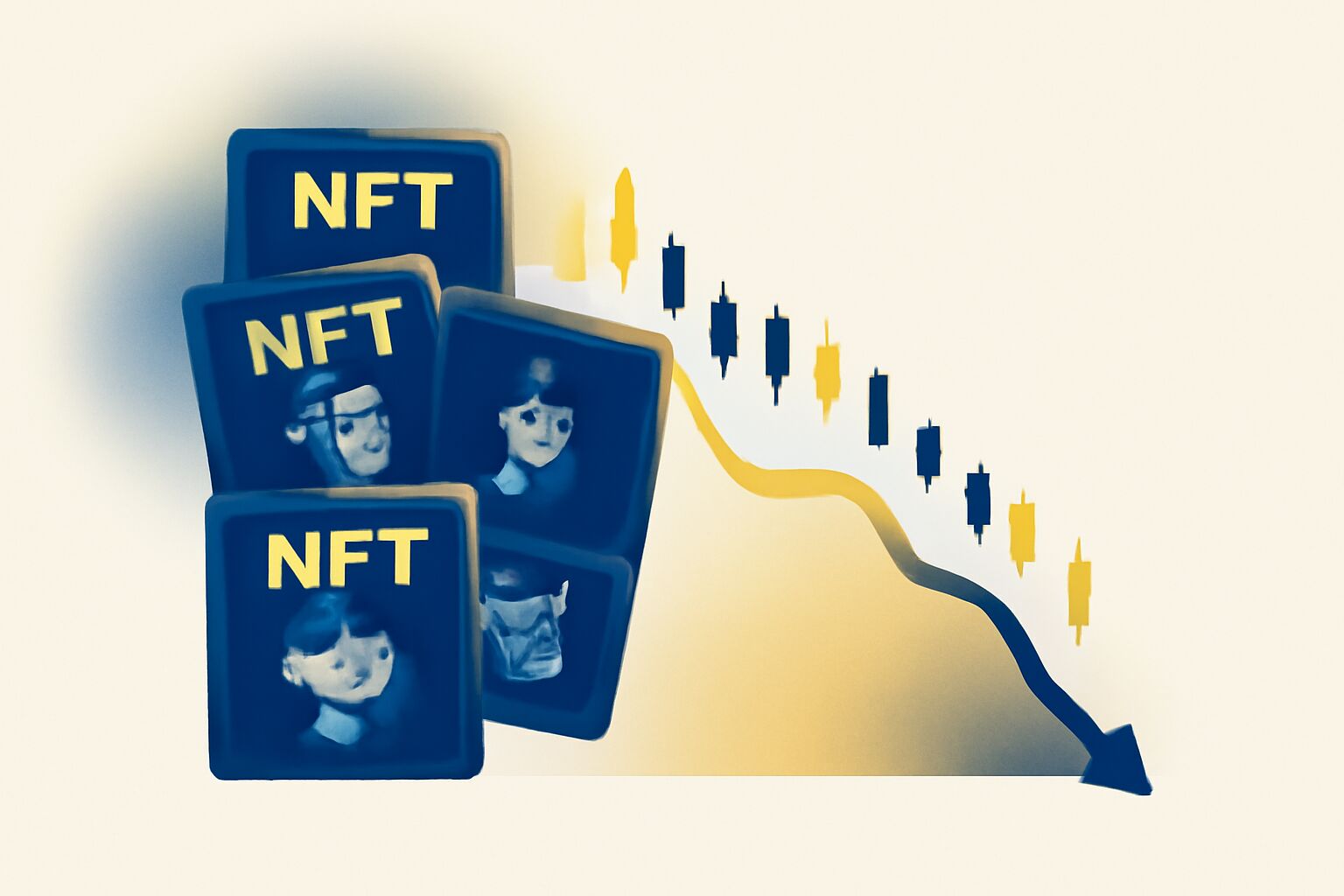
NFT collections exploded in 2021–2022, then crashed harder than most crypto assets. Rather than memorize which collection sold for millions, traders need to understand what actually moves NFT prices and why collection-based narratives break down in a bear market.
The Narrative vs. the Mechanics
Most NFT education focuses on storytelling: a collection's origin story, its cultural impact, or the headline sale price. This is marketing, not trading analysis.
When CryptoKitties launched in 2017, the story was novel—digital scarcity enforced by blockchain. When Bored Ape Yacht Club gained traction, the narrative shifted to community membership and access rights. Both stories attracted capital, but neither explained how to value a floor price or time an exit.
Traders who entered based on narrative alone got crushed in 2023. Why? Because narratives cannot be quantified in real time. You cannot build a risk model on "exclusive community vibes." You cannot backtest entry and exit rules based on "cultural significance."
The mistake was treating NFT collections like equities with fundamentals, when they behave more like penny stocks—driven by sentiment, whale accumulation, and hype cycles rather than cash flow or utility.
Floor Price vs. Individual Sale Hype
The source material celebrates individual mega-sales (Beeple's $69M sale, record BAYC prices) as proof of value. But individual outliers are not market signals—they are volatility noise.
What matters to a trader is the collection's floor price—the lowest ask for any piece in that collection right now. This is what you can actually transact at.
A $69M sale by Beeple tells you that one buyer valued one piece that highly at one moment. It does not tell you whether the next Beeple NFT will trade for $60M or $6M. Floor prices, by contrast, move continuously and reflect real market consensus on the collection's liquidity and desirability.
In 2022, floor prices across major collections (BAYC, CryptoPunks, etc.) tanked 80–90% because they had no underlying income stream. When the narrative faded, there was no cash flow or reserve demand to support a bottom. A trader monitoring floor price trends on a 4-hour or daily chart would have exited far earlier than someone waiting for the next hype story.
Liquidity Traps and Concentration Risk
Each NFT collection has vastly different liquidity profiles. CryptoKitties and Art Blocks, pitched as "movements," had deep liquidity early on—many concurrent buy/sell orders. But most collections are thin: only a handful of daily transactions, and a single whale purchase can move the floor 20% in minutes.
This creates two traps for retail traders:
Entry trap: You see a floor price on-chain and assume you can buy at that level. In reality, thin order books mean you'll slippage hard or wait hours for a fill.
Exit trap: When sentiment shifts, liquidity evaporates faster than in equities. If you own an NFT in a collection with 5 daily traders, your "floor price" might be $10K on data feeds—but the actual buyer pool might only absorb $2K. You'll take a 80% haircut on exit if you're in a hurry.
No source material on NFT collections discusses this. Yet it is the single biggest practical risk a retail trader faces when building an NFT position.
Why Collection-Based Analysis Doesn't Scale
Traders who studied notable NFT collections and tried to predict which would "moon" next were solving the wrong problem.
The question isn't "Which collection will become culturally significant?" It's "Which collection has enough real buyer demand to trade profitably over my intended holding period?"
Those are different. CryptoKitties was historically significant and culturally important. It was also illiquid by 2023 and would have cost you money to exit a large position.
Bayc and CryptoPunks benefited from early-mover status and narrative density. They captured cultural attention. But cultural attention alone is not a trading edge. When the hype cycle turns, culture doesn't keep prices up. Neither does pixel count, rarity, or membership promises.
What keeps prices up: sustainable utility (can you earn yield with this NFT?), real secondary-market demand (are new buyers entering every week?), and institutional adoption (are hedge funds or major exchanges liquidity providers?).
Most collections fail on all three counts. And no amount of celebratory storytelling changes that.
Building a Real NFT Trading Framework
If you want to trade NFTs profitably, drop the collection-history deep dive. Instead:
Track on-chain floor price data using a tool like Dune Analytics or a TradingView-equivalent for NFT collections. Plot floor prices as a time series. Look for: trend reversals, liquidity changes, and false-breakouts where the floor moves up on a single whale trade but buyer depth doesn't support it.
Measure bid-ask spread. Thick bid-ask spreads (>10% difference between floor and next ask) signal illiquidity. Avoid these.
Monitor whale wallets. Large holders accumulating or dumping is a real signal. Culture and narrative are not. Use blockchain explorers to track large transfers in and out of collections.
Size for liquidity. If you're entering an NFT position, buy only what you can exit in <1 hour at <5% slippage. If the collection is too thin, it's not a trade—it's a speculative gamble.
Define an exit rule. Don't wait for "the next Beeple sale" or cultural validation. Set a price target (profit) and a stop loss (risk limit). Treat the NFT like any other volatile asset: profit at plan, loss at limit.